Remote Expert Assistance Compared With Recurring Technician Travel
The decision is about when the team can reach a specialist: during the task, or after another journey to the site.
Field-service expense rises fast if the first appointment fails to resolve a technical issue.
A technician may arrive with the wrong replacement part or find a problem that needs a more experienced specialist. The customer’s description may have missed a symptom, or the fault may involve a different system than expected.
Another appointment is frequently the outcome.
Then one more after that.
Travel time, labor expense, schedule delays and downtime for the customer accumulate with every journey. A request that first looked straightforward can stretch into a lengthy, costly process.
A different path is available through remote expert support.
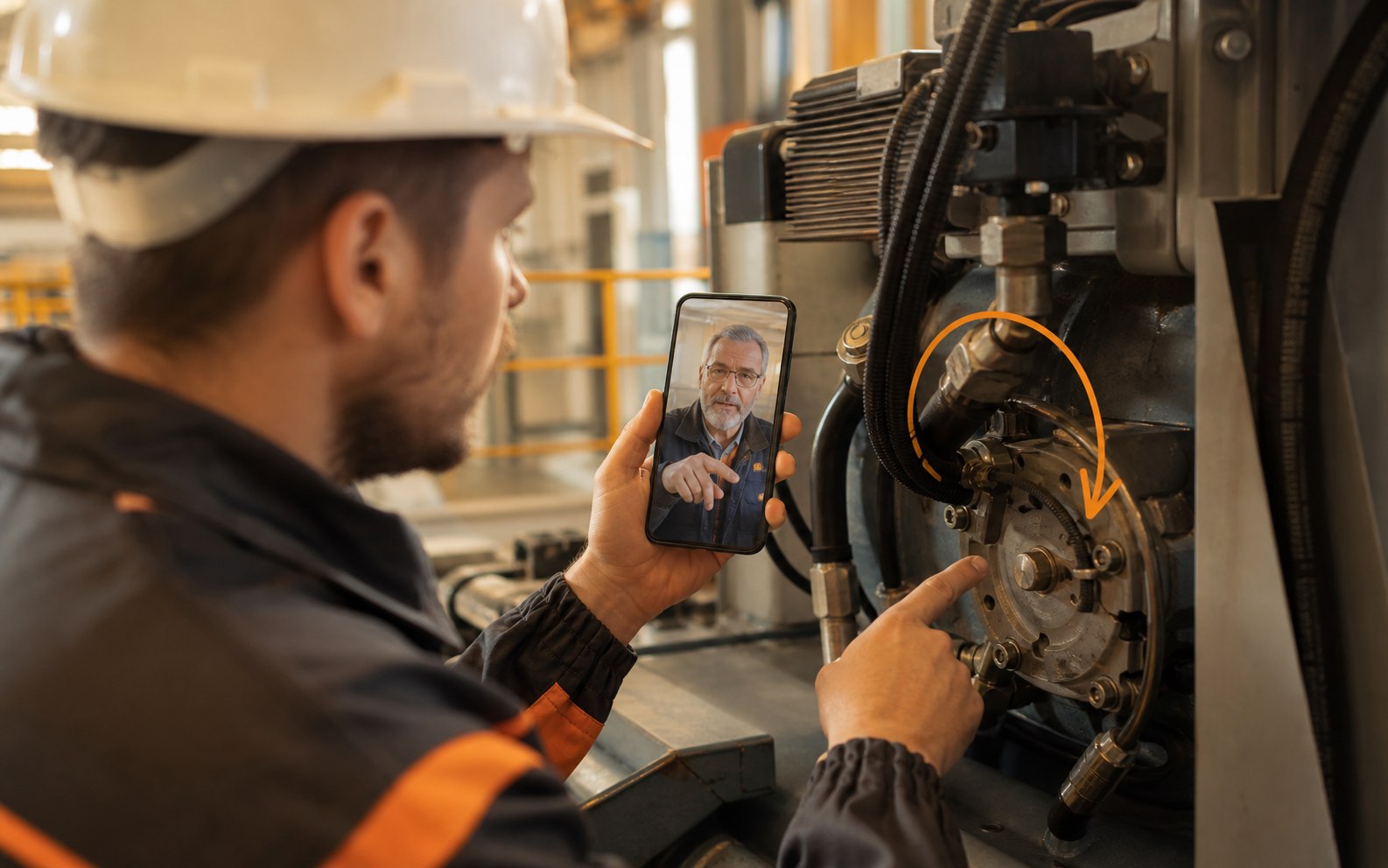
Companies can put technical knowledge within remote reach rather than ferrying it to the customer again and again. Live video can link a field technician, local employee or customer with a seasoned expert, who then offers visual guidance during inspection or repair of the equipment.
The decision is about when the team can reach a specialist: during the task, or after another journey to the site.
Why Service Calls So Often Have to Happen Again
Several factors can keep a service visit from solving the problem.
Before travelling, the technician might lack sufficient information. The specialist who is needed might not be free. Tools or parts that are correct might have been left out. Intermittent faults that are hard to reproduce during the visit can also be to blame.
Repeat visits commonly stem from:
- Problem descriptions that leave out details
- An opening diagnosis that is wrong
- Replacement parts that were not brought
- Specialist knowledge that is absent
- Weak communication with the customer
- Equipment configurations that were not expected
- Extra faults found while the repair is underway
- Approval required from a senior technician
Poor service is not always the cause of these situations. Complexity in technical systems is common, and pre-visit information is frequently limited.
Beginning with travel rather than diagnosis is how traditional field service processes usually work, and that is the problem.
Dispatch happens first; only after someone is on-site does the organization learn what the problem truly is.
Diagnosis can start, thanks to remote expert support, before another journey is booked.
A Second Visit Costs More Than Another Travel Invoice
Businesses often fixate on the direct expense of going back to the site if the first visit fails to solve the issue.
The full cost, however, stretches far wider.
Included in a repeated visit may be:
- Extra technician labor
- Transportation expenses, fuel or tolls
- Maintenance and vehicle wear
- Meal costs and accommodation
- Other customers having to be rescheduled
- Payments for overtime
- Coordination on the administrative side
- Customer downtime that continues
- Customer confidence that is reduced
Some of the same diagnostic steps from the first visit may also have to be repeated by the technician.
More waiting, more disruption and another stretch during which equipment may stay unavailable are what another appointment means for the customer.
Someone still absorbs the cost through reduced service margins, lost productivity or lower customer satisfaction, even if the company does not bill the customer for the return visit.
The Technician Already On-Site Can Be Supported by Remote Experts
Sending a senior specialist is often the traditional solution once a field technician hits the limit of their experience.
Several hours of travel or booking the visit for another day may be required.
The specialist can join the service session at once when remote expert support is available.
Equipment, surrounding connections, control panels and damaged components can be shown by the field technician on a smartphone. Observation, questions and guidance through further diagnostic steps can then come from the remote expert.
Visual instructions the expert can add to the live view with GuideMeAR include:
- Specific components indicated by arrows
- Areas that require inspection circled with drawings
- Where a cable should connect, shown with markers
- Directions in visual form for taking a part off
- Guidance through a repair, one step at a time
- Areas that should not be touched, marked with warnings
Attempting to explain a complex machine over a phone call is less effective than this.
Travel is unnecessary for the senior expert, and the technician on-site still gains access to the knowledge needed to continue the work.
Multiple Locations Can Be Assisted by One Remote Expert
Only one location at a time can normally be served by a travelling senior technician.
The journey may consume most of the working day even when the repair itself takes less than an hour.
Several field technicians or customers can be supported by a remote expert during that same period.
An expert could, for example:
- Identify a faulty sensor with one technician
- Walk another through replacing a component
- Look over an installation at a third customer location
- Determine whether an on-site specialist is required for a fourth issue
The reach of experienced employees increases significantly as a result.
Rather than becoming unavailable while driving between locations, the expert stays available to the entire service organization.
Dependence on having a senior specialist physically located near every customer can fall for companies that operate across multiple cities, regions or countries.
The Next On-Site Visit Improves After Remote Diagnosis
Travel is not always eliminated by remote expert support.
Physical intervention, specialized tools, certified personnel or complex mechanical work is required for some repairs. Making the necessary visit as productive as possible is the objective in those cases.
The service team can use a remote inspection to determine:
- The specialist who should be sent
- The parts that are likely to be required
- The tools that should be prepared
- The amount of time the repair may take
- If the equipment must be shut down
- If additional safety procedures are needed
- If the customer must prepare the site
First-time fix rates can improve with this information, and the likelihood of another return trip can fall.
Someone with a clearer diagnosis and a better repair plan can be sent, rather than a technician who has only a written description of the problem.
Escalation Delays Shrink With Remote Support
Escalation is often slow in traditional service workflows.
A supervisor may be called by a junior technician, who then explains the problem and waits for a response. Photographs, documentation or another phone call may be requested by the supervisor. A senior technician visit may be scheduled by the company if the issue remains unclear.
Delay is introduced at each step.
Escalation becomes immediate and visual with live remote assistance.
What the on-site technician sees is also seen by the expert. The same equipment can be discussed in real time by both people, rather than relying on a verbal description.
Common misunderstandings that this reduces include:
- Pointing to the wrong component
- Identifying a connector incorrectly
- Mixing up similar error messages
- Reading instructions in different ways
- Missing damage outside the expected area
Progress can continue while the technician is still at the customer's location, thanks to faster escalation, rather than leaving and coming back later.
Customer Confidence Is Easier to Preserve With Remote Expert Support
The internal complexity behind a repair is rarely visible to customers.
A technician arriving, inspecting the equipment and leaving without solving the problem is what they see.
The customer may begin to question the service provider's preparation or expertise once another appointment is required. Frustration can arise from repeated visits even when the technical issue is genuinely difficult.
Showing that the service team is actively collaborating to resolve the issue is one way remote support can improve the customer experience.
During the original visit, a field technician can connect with a specialist, keep troubleshooting and explain that additional expertise is already involved.
A clearer diagnosis and a more specific next step still reach the customer even when the repair cannot be completed immediately.
Being told that someone else will need to return at an unknown time is less reassuring than this.
Knowledge Ought to Move Quicker Than Personnel
A small group of senior technicians is something many service organizations depend heavily on.
Years of practical knowledge that manuals or standard troubleshooting guides cannot easily replace are often held by these employees.
Moving the person is how the traditional service model moves that knowledge.
Knowledge is separated from location by remote expert support.
While helping someone hundreds of kilometres away, the experienced technician can remain at the office, at home or at another worksite.
The importance of senior technicians is not reduced by this. Their expertise can be used more efficiently.
The expert can contribute to several service cases and focus on the parts of each issue where their experience creates the most value, instead of spending hours travelling to one problem.
Junior Technicians Also Develop Through Remote Guidance
The immediate problem may be solved by repeatedly sending senior technicians, yet the capabilities of the wider team gain little.
Direct participation in the diagnosis and repair happens when junior technicians receive live remote guidance.
How the expert evaluates symptoms, selects tests and reaches conclusions can be observed. Experience performing procedures that they may later be able to complete independently is also gained.
An ongoing form of practical training is created this way.
Organizations can, over time, use remote collaboration to:
- Raise technician confidence
- Make repair methods more consistent
- Cut down on unnecessary escalations
- Pass on specialist knowledge
- Make employee training periods shorter
- Raise the number of issues resolved by local teams
Support from the senior technician remains available, yet the organization becomes less dependent on sending them to every difficult case.
The Two Service Models Side by Side
Take a technical issue that needs input from a senior specialist.
Technician travel that is repeated
The customer is visited by a field technician who cannot complete the repair. Another day is then scheduled for a senior technician. Waiting continues for the customer, the equipment stays unavailable and another journey is paid for by the company.
A third visit may be required if the specialist arrives without the correct part.
Support from a remote expert
While still on-site, the field technician connects with a senior expert. Visual instructions are provided, the equipment is seen and the fault is confirmed with the expert's help.
Immediate resolution of the issue is possible.
The company already knows which part, specialist and tools are required before anyone travels again, when a follow-up visit is still necessary.
Solving every problem is not the main advantage of remote support. Reducing uncertainty before the company commits to another site visit is.
In Which Situations Does Technician Travel Remain the Right Choice?
Work that requires physical expertise, certification or strict safety control should not have remote support used as a replacement.
Cases in which an on-site senior technician may still be necessary include:
- High-voltage systems are involved in the repair
- Required measuring equipment is specialized
- Certified personnel are required by regulations
- Significant safety risks are presented by the work
- Needed mechanical disassembly is complex
- Completing the task safely is beyond the local technician
- Access to the equipment is physically restricted
Neither a remote-only nor an on-site-only approach is the best service strategy.
A hybrid process comes first: remote diagnosis and guidance, then travel when physical presence creates clear value.
A Service Process That Starts Remote
A simple remote-first workflow can be introduced so companies reduce repeated travel.
Step 1: Start through a visual inspection
Have the customer or local employee show the equipment through a live video session.
Step 2: Bring in the appropriate expert
Link the person on-site with a technician who has experience with the relevant equipment or fault.
Step 3: Lead a basic diagnosis
Inspect components, check connections and review error indicators using visual instructions.
Step 4: Try resolving the issue safely from remote
Walk the customer or local technician through steps they are qualified and comfortable performing.
Step 5: Set up a well-informed dispatch
Send the correct technician with the required parts, tools and information once travel is necessary.
Dispatching people based only on incomplete descriptions is what this workflow helps companies avoid.
Cut Repeat Visits with GuideMeAR
Field technicians, customers and remote experts can be connected by service teams through live video and augmented reality guidance with GuideMeAR.
A modern smartphone is all the person on-site needs. Specialized AR glasses, cameras or complicated equipment are not required.
The problem can be seen by remote experts, who can point to components, draw over the live view and guide the person through each step. Technical communication becomes clearer, and service teams can decide whether an additional visit is truly necessary.
Businesses that use GuideMeAR before scheduling another technician journey can:
- Bring down repeat service visits
- Raise first-time fix rates
- Cut customer downtime shorter
- Make senior experts more available
- Give support to junior technicians
- Strengthen dispatch preparation
- Bring travel and labor costs down
Travel by senior technicians should happen when their physical presence is essential.
Immediate availability of their knowledge, however, should still be the rule.
Expert support can reach the customer faster than any service vehicle with GuideMeAR.
Travel by senior technicians should happen when their physical presence is essential.
Expert support can reach the customer faster than any service vehicle with GuideMeAR.